How Does Industrial Hose Flexibility Affect Installation and Performance?
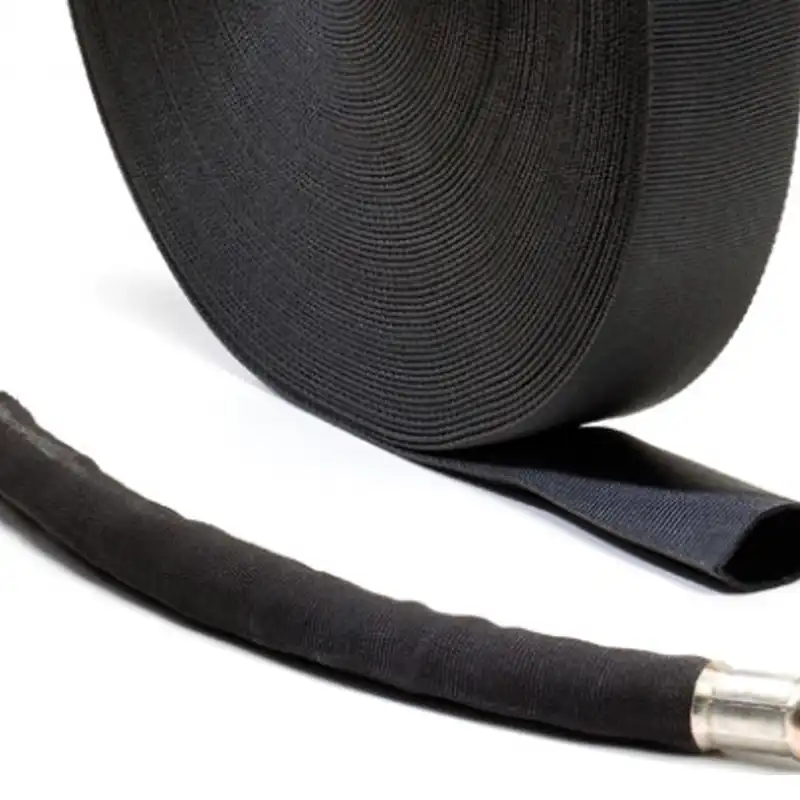
Industrial hose flexibility affects how easily a hose can be routed, how much force reaches its fittings, and how long the assembly can handle repeated movement. A modern SAE 100R16 hose can require up to 40% less force to bend than conventional designs, while qualified products may complete 600,000 pressure-impulse cycles. Bend radius matters just as much: a 1-inch high-pressure hose may need about 6 inches of radius even though it appears capable of bending further. Pressure, temperature, reinforcement, diameter, routing, and motion all change the result. Flexibility works best when the hose bends without flattening, twisting, stretching, or loading its couplings.
A hose normally contains an inner tube, one or more reinforcement layers, and an outer cover. The tube provides fluid compatibility, while textile braid, steel-wire braid, or spiral wire carries pressure forces. The construction creates an engineering compromise: more reinforcement can support higher pressure, but additional wire and wall thickness can increase bending force. Gates, for example, lists its MXT SAE 100R16 wire-braid hose as requiring up to 40% less force-to-bend while still being tested to 600,000 impulse cycles. That combination matters during installation because flexibility cannot be judged by hand feel alone.
Installation force eventually reaches another part of the assembly. When a technician has to pull a stiff hose sideways to align it with a port, the hose continues trying to return toward its natural position after the fitting has been tightened. Side loading then acts on threads, flanges, adapters, clamps, and the hose-to-coupling transition. A lower bending force reduces the effort needed to position the assembly and can reduce residual stress, especially inside compact mobile equipment where several lines may occupy less than a few inches of clearance.
A hose that can physically be bent into a space is not automatically suitable for operating at that bend.
Minimum bend radius provides a better limit than visual judgment. Gates lists a 3/4-inch ID ID5K spiral-wire hose at a minimum bend radius of 4.7 inches, while its 1-inch version requires 6 inches. Both are rated to 5,000 psi working pressure and 20,000 psi minimum burst pressure, giving a 4:1 relationship between those published values. The larger hose therefore needs about 28% more bend radius, despite sharing the same pressure rating.
That diameter effect becomes important when engineers plan routing before the hose is installed. Increasing internal diameter may reduce velocity and friction loss, yet a larger hose usually occupies more space and carries more mass. A 1-inch hose filled with hydraulic oil also weighs considerably more than the same empty hose. When unsupported length increases, gravity can pull the hose downward and create bending close to the fitting, so clamps or guides may be needed even when the hose itself is flexible.
Routing geometry also changes internal flow. A gradual bend normally keeps the bore close to its intended circular shape, whereas a bend below the specified radius can flatten the tube or distort reinforcement. If a circular flow area were reduced by only 10% because of deformation, local velocity would need to rise by roughly 11% to maintain the same volumetric flow rate. Higher local velocity can add pressure loss and heating, so installation geometry can affect system efficiency without any visible external leak.
The situation becomes more demanding on suction lines. Positive-pressure reinforcement resists expansion, while suction service also requires enough structural support to resist inward collapse. A soft hose may route easily around equipment but can become unsuitable when inlet pressure falls below atmospheric pressure. For that reason, flexibility, vacuum rating, wall construction, and bend radius need to be considered together rather than selecting a hose because it feels easier to bend.
| Installation condition | What excessive stiffness can cause | What excessive flexibility can cause |
|---|---|---|
| Tight equipment space | Difficult routing, fitting side load | Kinking at sharp turns |
| Pump connection | More vibration transferred to plumbing | Excessive movement without support |
| Suction service | Difficult alignment | Tube flattening or collapse |
| Repeated machine movement | High localized bending force | Uncontrolled rubbing or twisting |
| Large-bore line | Greater handling effort | Sagging when fluid-filled |
Pressure cycles add another layer because a hose changes slightly in diameter and length whenever internal pressure rises and falls. Heavy mobile and industrial equipment can generate thousands of pressure changes during one working shift. A hose placed in a tight bend experiences pressure stress and bending stress at the same location, which is why impulse qualification uses repeated pressure cycles rather than a single proof-pressure event. Gates reports 600,000-cycle testing for several wire-braid products, while its ID5K spiral hose is listed as tested to as many as 2.3 million impulse cycles.
Repeated bending can be more demanding than a stationary curve. A hose connecting a fixed hydraulic valve to a moving boom, steering cylinder, or articulated attachment may bend every few seconds. At one movement every 5 seconds during an 8-hour shift, the assembly could experience about 5,760 movements per shift. Over 250 operating days, that is approximately 1.44 million movements in a year, although real equipment usage and movement amplitude vary widely.
That movement should occur through a broad section of the hose rather than immediately behind a coupling. A fitting makes the hose end locally stiffer, so forcing a sharp curve beside the ferrule concentrates deformation near the transition from rigid coupling to flexible hose. Providing enough straight length after the fitting allows curvature to develop farther into the hose body. It also leaves room for pressure-induced movement instead of making the connection absorb it.
Twisting needs separate attention because a hose designed to bend is not necessarily designed to operate under continuous torsion. A 90-degree error in fitting orientation can make an otherwise generous routing path place rotational stress into the reinforcement. Multi-axis machine movement can create the same problem when both hose ends are fixed. Swivel fittings, correctly oriented angled fittings, or a revised hose path may reduce torsion without requiring a softer hose.
Temperature then changes the amount of force needed to achieve the same movement. Elastomers generally become less compliant as temperature falls, while elevated temperatures can soften compounds and reduce mechanical margins. One Gates high-pressure spiral hose lists a continuous operating range from -40°F to +250°F (-40°C to about 121°C), a span of 290°F. A hose selected after being handled at 70°F should therefore not be assumed to bend the same way during winter startup or near hot engine components.
Abrasion becomes easier to control once expected movement is known. A flexible line that changes position under pressure can contact another hose, a steel bracket, or a machine frame thousands of times. Cover construction then matters alongside bend characteristics. Gates states that its XtraTuff cover can last up to 25 times longer than a standard cover in specified abrasion testing, while MegaTuff versions are rated up to 300 times longer under ISO 6945 hose-to-hose and hose-to-metal abrasion testing. Those numbers describe laboratory comparisons, not guaranteed field life, but they show why routing and cover selection should be considered together.
For procurement, comparing only working pressure can therefore produce two hoses that look equivalent on paper but behave very differently during assembly. A useful specification should include nominal ID, working pressure, minimum burst pressure, bend radius, temperature range, reinforcement type, cover resistance, fluid compatibility, coupling system, and whether the line remains stationary or moves repeatedly.
-
A 5,000 psi rating does not show how tightly the hose can bend.
-
A 6-inch bend radius does not show whether the hose is approved for 1 million repeated flex movements.
-
A -40°F rating does not describe abrasion resistance.
-
A 4:1 burst-to-working-pressure relationship does not permit operation above the published working-pressure limit.
Published standards make comparisons easier, but part numbers still need individual checking. SAE J517 includes hydraulic-hose constructions such as SAE 100R-series types, while ISO 18752 classifies hydraulic hoses around pressure and performance requirements. A product can also exceed part of a standard rather than behave identically to every other hose carrying the same specification. Manufacturer tables remain necessary for bend radius, coupling compatibility, temperature, and size-specific pressure data.
The installation team can use those values before cutting an assembly. The required path should be measured with the equipment in all relevant positions rather than only when the machine is parked. If a cylinder or articulated arm changes hose distance by 15% through its travel, a hose sized only for the shortest position can become tensioned at full extension. Extra length should provide a controlled bend, not a loose loop that rubs against nearby components.
Routing should let the hose bend naturally while keeping tension, compression, torsion, and surface contact within the manufacturer's limits.
Maintenance inspections then provide information that catalog specifications cannot. Flattened sections, polished cover areas, exposed reinforcement, cracked rubber, displaced clamps, leakage near ferrules, or a hose that becomes noticeably stiffer can show that the installed geometry no longer matches operating conditions. Replacement intervals should therefore reflect actual application severity rather than a universal calendar period; equipment accumulating 2,000 operating hours per year is not exposed in the same way as equipment used for 200 hours.
Product selection can apply the same approach to Kingdaflex hydraulic hoses: compare the exact hose series by pressure rating, bend radius, reinforcement, temperature capability, fluid compatibility, and approved fittings instead of treating the brand name or hose diameter as a complete specification. A 2026 purchasing specification can also record the selected hose standard and part number so replacement assemblies are not later substituted solely because another hose has the same inside diameter.
Flexibility therefore belongs in the same engineering check as pressure and media compatibility. A hose with 40% lower bending force may reduce installation effort, while a product qualified for 600,000 or more impulse cycles may better suit repeated-pressure service; neither number alone establishes suitability. The hose still has to maintain its bore, stay above its minimum bend radius, avoid torsion, remain within its temperature rating, use compatible fittings, and move without rubbing against surrounding equipment.